
The Southern Highland Zone constitutes Tanzania’s principal agricultural belt, accounting for approximately fifty percent of the nation’s food supply. Most of the soil of the region’s agroecozones is strongly acidic, causing poor crop yields and inefficient fertilizer utilization. Phosphorus (P) sorption characteristics were investigated across acidic soils to assess their implications for P availability and soil fertility management. Surface soil samples (0-30) cm sampling depth obtained from the unlimed and limed plots of study sites were analyzed for P-sorption dynamics. The P-sorption data were fitted to the Freundlich isotherms to estimate sorption capacities and heterogeneity of adsorption sites. The results on Freundlich P-adsorption capacity (KF) in mg/Kg of soil recorded 1433.0±131.0 and 1396.6±141.7, 971.0±222.4 and 883.3±269.5, 1644.2±26.3 and 1595.7±43.0, 1055.4±62.3 and 1001.9±105.5; standard phosphorus requirement (SPR) in mg/Kg of soil 223.0±5.8 and 205.1±13.2, 122.8±17.7 and 104.7±18.4, 235.4±5.0 and 221.6±3.0, 113.3±19.0 and 97.9±13 for unlimed and limed experimental plots at Mbimba, Kifyulilo, Igeri and Uyole respectively. These results revealed strong P adsorption trends. Liming substantially reduced P-sorption capacities and heterogeneity of adsorption sites in the soil, increased equilibrium P concentration, indicating improved P availability through charge neutralization and reduced activity of iron (Fe) and aluminum (Al) sesquioxides. The SPR computed values indicated that the external addition of phosphorus according to national recommendations provide suboptimal fertilization of phosphorus in the Southern Highlands of Tanzania. These findings highlight that managing soil acidity through liming is essential to minimize P-adsorption and enhance fertilizer use efficiency in low-P tropical soils.
| Published in | American Journal of Agriculture and Forestry (Volume 14, Issue 5) |
| DOI | 10.11648/j.ajaf.20261405.11 |
| Page(s) | 229-240 |
| Creative Commons |
This is an Open Access article, distributed under the terms of the Creative Commons Attribution 4.0 International License (http://creativecommons.org/licenses/by/4.0/), which permits unrestricted use, distribution and reproduction in any medium or format, provided the original work is properly cited. |
| Copyright |
Copyright © The Author(s), 2026. Published by Science Publishing Group |
Phosphorus Adsorption, Phosphorus Fixation, Sesquioxides, Variable Charge
Site name | Latitude Longitude | Altitude (masl) | Precipitation (mm) | landform | Land use | USDA Soil Taxonomy |
|---|---|---|---|---|---|---|
Mbimba | -9.08835, 32.95329 | 1592 | 1300-1800 | Flat plain | Cultivation | clayed, mixed, superactive, isothermic Ultic Hapludalf |
Igeri | -9.53057, 34.72591 | 2023 | 1200-2100 | Inclined plain | Cultivation | clayey, mixed, semiactive, isothermic Typic Hapludult |
Kifyulilo | -8.69118, 35.12511 | 1848 | 1000-1700 | Inclined plain | Cultivation | Fine, mixed, active, isothermic Typic Paleudult |
Uyole | -8.91611, 33.50793 | 1770 | 100-1500 | Alluvial fan | Cultivation | Pumiceous, mixed, superactive, isothermic, Typic Hapludand |
Site | Trt | pHw | Bray I - P mg/kg | Exch. Ca Cmol/kg | Exch.Acidity Cmol/Kg | Exch. Al Cmol/Kg |
|---|---|---|---|---|---|---|
Mbimba | Unlimed | 5.06d | 2.82c | 5.14bc | 2.30a | 1.95a |
Limed | 5.93bc | 11.15b | 17.10a | 1.16b | 0.92b | |
Igeri | Unlimed | 5.23d | 3.38bc | 1.43c | 0.58c | 0.49c |
Limed | 5.58bcd | 4.27bc | 2.07c | 0.17e | 0.16e | |
Kifyulilo | Unlimed | 5.51cd | 3.98bc | 6.12bc | 0.27d | 0.32d |
Limed | 5.89bc | 6.00bc | 9.97b | 0.12ef | 0.09ef | |
Uyole | Unlimed | 6.1ab | 19.21a | 4.35bc | 0.07f | 0.02f |
Limed | 6.47a | 26.54a | 7.97b | 0.05f | 0.02f | |
Site | *** | *** | *** | *** | *** | |
Lime | * | ns | Ns | *** | *** | |
Site*Lime | * | * | *** | *** | *** | |
Cv (%) | 3.29 | 28.50 | 29.81 | 5.28 | 5.4 | |
P value | *** | *** | *** | *** | *** | |
Property | Mbimba | Igeri | Kifyulilo | Uyole | HSD (0.05) | Unlimed | Limed | LSD (0.05) |
|---|---|---|---|---|---|---|---|---|
SOC (%) | 2.11b | 3.22b | 3.73a | 2.00b | 0.22 | 3.21a | 2.52b | 1.0614379 |
CEC (cmolc kg-1) | 30.78a | 28.62b | 26.63c | 28.63b | 0.22 | 24.68b | 26.28a | 1.06 |
Fe (ppm) | 250.78a | 178.00b | 153.10b | 320.61a | 0.220 | 178.00a | 147.05a | 1.06 |
Site | Trt | KF | p-value | n | P-value |
|---|---|---|---|---|---|
Mbimba | Unlimed | 1433.0 ± 131.0 | 0.758 | 0.66± 0.05 | 0.7197 |
Limed | 1396.6 ± 141.7 | 0.69 ± 0.02 | |||
Igeri | Unlimed | 1644.2± 26.3 | 0.171 | 0.70 ± 0.01 | 0.102 |
Limed | 1595.7 ± 43.0 | 0.72 ± 0.02 | |||
Kifyulilo | Unlimed | 971.0± 222.4 | 0.6859 | 0.75 ± 0.05 | 0.5022 |
Limed | 883.3± 269.5 | 0.82 ± 0.08 | |||
Uyole | Unlimed | 1055.5 ± 62.3 | 0.492 | 0.83 ± 0.03 | 0.0042 |
Limed | 1001.9 ± 105.5 | 0.97 ± 0.03 |
Site | Trt | PBC (L/Kg) | P-value | SPR (mg/Kg) | P-value |
|---|---|---|---|---|---|
Mbimba | Unlimed | 1634.6±148.5 | 0.7294 | 223.0 ± 5.8 | 0.097 |
Limed | 1588.37 ± 156.5 | 205.1 ± 13.2 | |||
Igeri | Unlimed | 1866.0± 31.0 | 0.1104 | 235.4 ± 5 | 0.0165 |
Limed | 1803.9 ± 42.5 | 221.6± 3.0 | |||
Kifyulilo | Unlimed | 1078.48 ±228.2 | 0.6035 | 122.8 ±17.7 | 0.2859 |
Limed | 965.3± 264.5 | 104.7 ± 18.4 | |||
Uyole | Unlimed | 1121.6 ± 91.8 | 0.3956 | 113.3 ± 19.0 | 0.311 |
Limed | 1039.5± 118.1 | 97.9 ± 13.0 |
Site | Trt | P requirements Kg /ha | Existing P recommendation (Kg/ha) |
|---|---|---|---|
Mbimba | Unlimed | 421.77 | 25 |
Mbimba | Lime | 402.62 | 25 |
Igeri | Unlimed | 483.64 | 10 |
Igeri | Lime | 452.61 | 10 |
Kifyulilo | Unlimed | 216.50 | 20 |
Kifyulilo | Lime | 191.98 | 20 |
Uyole | Unlimed | 203.95 | 25 |
Uyole | Lime | 158.17 | 25 |
TARI | Tanzania Agricultural Research Institute |
ISU | Iowa State University |
KF | Freundlich Adsorption Capacity |
SPR | Standard Phosphorus Requirement |
PZC | Point of Zero Charge |
USDA | United States Department of Agriculture |
GPS | Global Positioning System |
TRIT | Tea Research Institute of Tanzania |
ECCE | Effective Calcium Carbonate Equivalence |
PSD | Particle Size Distribution |
NSS | National Soil Survey |
CEC | Cation Exchange Capacity |
TARI | Tanzania Agricultural Research Institute |
ISU | Iowa State University |
KF | Freundlich Adsorption Capacity |
SPR | Standard Phosphorus Requirement |
| [1] | P. Marschner, Marschner's Mineral Nutrition of Higher Plants, 3 ed., Elsevier, 2012. |
| [2] | P. I. Massawe, "Constrains, Production Systems and Roles of Phosphorus in Rice Production in Tanzania," Asian Journal of Soil Science and Plant Nutrition, pp. 1-10, 2017. |
| [3] | P. C. Smithson and K. E. Giller, "Appropriate farm management for alleviating N and P deficiencies in low-nutrient soils of the tropics," plant and Soil, vol. 245, pp. 169-180, 2002. |
| [4] | S. S. Mahdi, M. A. Talat, M. Dar, A. Hamid and L. Ahmad, "Soil Phosporus Fixation Chemistry and Role of Phosphate Solubilizing Bacteria in Enhancing it Efficiency for Sustainable Cropping A review.," Journal of Pure and Applied Microbiology, vol. 6, no. 4, pp. 1905-1911, 2012. |
| [5] | P. A. Sanchez and G. Uehara, "Management considerations for Acid Soils with High Phosphorus Fixation," in The Role of Phosphorus in Agriculture, Madison, ASA-CSSA-SSSA, 1980, pp. 471-514. |
| [6] | M. T. Iqbal, "Acid tolerance mechanisms in soil grown plants," Malaysian Journal of Soil Science, pp. 1-21, 2012. |
| [7] | L. R. Alleoni, M. A. Cambri, E. F. Caires and F. J. Garbuio, "Acidity and Aluminum Speciation as Affected by Surface Liming in Tropical No-Till Soils," Soil Science Society of America, pp. 1010-1017, 2010. |
| [8] | P. S. Bindraban, C. O. Dimkpa and R. Pandey, "Exploring phosphorus fertilizers and fertilization stratergies for improved human and environmental health.," Biology and Fertility of Soils, vol. 56, pp. 299-317, 2020. |
| [9] | G. Nziguheba, S. Zingore, J. Kihara, R. Merckx, S. Njoroge and A. Otinga, "Phosphorus in smallholder farming systems of sub-Saharan Africa: Implications for agricultural intensification.," Nutr Cycl Agroecosyst, pp. 321-340, 2016. |
| [10] | Y. Arai and D. L. Sparks, "Phosphate Reaction Dynamics in Soil and Soil Components: A Multiscale Approach.," Advances in Agronomy, pp. 135-179, 2007. |
| [11] | P. A. Sanchez, Properties and management of soils in the tropics., New York: Cambridge university press, 2019. |
| [12] | S. Goldberg and G. Sposito, "On the mechanism of specific phosphote adsoprtion by hydroxylated mineral surface: A Review.," Communications in Soil Science and Plant Analysis, pp. 801-821, 1985. |
| [13] | J. G. Mtama, B. M. Msanya and C. L. Burras, "Pedology at Four Reprentative Sites of Southern Highland of Tanzania.," American Journal of Agriculture and Forestry, pp. 111-121, 2018. |
| [14] | N. K. Fageria and V. C. Baligar, "Amelioration of soil acidity of tropical Oxisols by liming for sustainable crop production," in Advances in Agronomy, Elsevier, 2008, pp. 345-399. |
| [15] | J. Zheng, W. N. Mmari, T. Nishigaki, M. M. Kilasara and S. Funakawa, "Nitrogen availability to maize as affected by fertilizer application and soil types in the Tanzanian highlands," Nutrient Cycling in Agroecosystems, vol. 112, pp. 197-213. |
| [16] | B. Ayenew, A. M. Tadesse, K. Kibret and A. Malese, "Phosphorus status and adsorption characteristics of acid soil from Cheha and Dinsho districts, Southern highlands of Ethiopia," Environmental System Research, vol. 7, no. 17, pp. 1-14, 2018. |
| [17] | M. D. Compos, J. A. Antonangelo and L. R. Alleoni, "Phosphorus sorption index in humid tropical soils.," Soil & Tillage Research, pp. 110-118, 2016. |
| [18] | K. Mbene, A. S. Tening, C. E. Suh, N. N. Fomenky and V. B. Che, "Phosphorus fixation and its relationship with physicochemical properties of soils on the astern flank of Mount Cameroon.," African Journal of Research, vol. 12, no. 36, pp. 2742-2753, 2017. |
| [19] | M. A. Tabatabai, D. L. Sparks, R. J. Bartlett, P. R. Bloom, C. E. Clapp, V. P. Evangelou and T. M. Young, Chemical Processes in Soils, Madison: Soil Science Society of America, Inc., 2005. |
| [20] | P. J. Schoeneberger, D. A. Wysocki, E. C. Benham and Soil Survey Staff, Field book for describing and sampling soils., Lincoln: Natural Resource Conservation Service, National Soil Survey Center, 2012. |
| [21] | J. Murphy and J. P. Riley, "A modified single solution method for determination of phosphate in natural waters," Analytica Chimica Acta, vol. 27, pp. 31-36, 1962. |
| [22] | F. S. Watanable and S. R. Olsen, "Test of an Ascorbic Acid Method for Determining Phophorus in Water and NaHCO3 Extracts from Soil," Soil Science Society of America Journal, vol. 29, no. 6, pp. 677-678, 1965. |
| [23] | G. W. Thomas, "Exchangeable Cations," in Methods of Soil Analysis, 1982. |
| [24] | H. D. Chapman, "Cation Exchange Capacity," in Methods of Soil Analysis, 1965. |
| [25] | E. O. McLean, "Soil pH and Lime Requirements," in Methods of Soil Analysis: Part 2 Chemical and Microbiological Properties, Second Edition ed., 1982. |
| [26] | D. W. Nelson and L. E. Sommers, "Total Carbon, Organic Carbon, and Organic Matter," in Methods of Soil Analysis: Part 2 Chemical and Microbiological Properties, Second Edition ed., 1982. |
| [27] | TANZANIA AGRICULTURAL RESEARCH INSTITUTE, Nation Soil Sevice Laboratory Procedures for Routine Soil Analyis, Tanga: Ministry of Agriculture, 2016. |
| [28] | Soil Survey Staff, Soil Taxonomy: A Basic System of Soil Classification for Making and Interpreting Soil Surveys, Second Edition ed., Washington, DC: United States Department of Agriculture Natural Resources Conservation Service, 1999. |
| [29] | H. Moazed, Y. Hoseini, A. A. Naseri and F. Abbasi, "Determining Phosphorus Adsorption Isotherm in Soil and its Relation to Soil Characteristics," International Journal of Soil Science, vol. 5, no. 3, pp. 131-139, 2010. |
| [30] | M. Thompson and F. Rivas, Environmental Soil and Water Chemistry Labotory Handbook, Ames: Agronomy Department, Iowa State University, 2022. |
| [31] | A. Buni, "Effects of Liming Acidic Soils on Imroving Soil Properties and Yield of Haricot Bean," Environmental & Analytical Toxicology, 2014. |
| [32] | T. Ameyu, "A Review on the potential effect of lime on soil properties and crop productivity improvements," Journal of Environment and Earth Science, pp. 17-23, 2019. |
| [33] | A. Nduwumuremyi, "Soil Acidification and Lime Quality: Sources of Soil Acidity, Effects on Plant Nutrients, Efficiency of Lime and Liming Requirements," Journal of Agriculture and Allied Sciences, pp. 26-34, 2013. |
| [34] | J. R. Okalebo, C. O. Othieno, K. W. Ndungu-Magiroi and M. N. Kifuko-Koech, "Potential for agricultural lime on improved soil health and agricultural production in Kenya.," in African Crop Science Conference Proceedings, 2009. |
| [35] | M. K. Miyittah, F. W. Tsyawo, K. K. Kumah, C. D. Stanley and J. E. Rechcigl, "Suitability of Two Methods for Determination of Point of Zero Charge (PZC) of Adsorbents in Soils," Communications in Soil Science and Plant Analysis, 2015. |
| [36] | E. Hanyabui, S. O. Apori, K. A. Frimpong, L. Atiah, T. Abindaw, M. Ali, Y. Asiamah and J. Byalebeka, "Phosphorus sorption in tropical soils," AIMs Agriculture and Food, vol. 5, no. 4, pp. 599-616, 2020. |
| [37] | P. O. Kisinyo, C. O. Othieno, S. O. Gudu, J. R. Okalebo, P. A. Opala, J. K. Maghanga, W. K. Ng'etich, J. J. Agalo, R. W. Opile, J. A. Kisinyo and B. O. Ogola, "Phosphorus Sorption and Lime Requirements of Maize Growing Acid Soils of Kenya," Sustainable Agriculture Research, vol. 2, no. 2, pp. 116-123, 2013. |
| [38] | Z. Wolde and W. Haile, "Phosphorus Sorption Isotherms and External Phosphorus Requirements of Some of Southern Ethiopia," African Crop Science Journal, pp. 89-99, 2015. |
| [39] | F. Hadgu, H. Gebrekidan, K. Kibret and B. Yitaferu, "Study of phosporus adsorption and its relationship with soil properties, analyzed with Langmuir and Freundlich models.," Agriculrture, Forestry and Fisheries, vol. 3, no. 1, pp. 40-51, 2014. |
APA Style
Mtama, J. G., Akitwine, F., Wokibula, R. A., Burras, C. L. (2026). Phosphorus Adsorption Characteristics of Soils in the Four Selected Agroecological Zones of Southern Highlands of Tanzania. American Journal of Agriculture and Forestry, 14(5), 229-240. https://doi.org/10.11648/j.ajaf.20261405.11
ACS Style
Mtama, J. G.; Akitwine, F.; Wokibula, R. A.; Burras, C. L. Phosphorus Adsorption Characteristics of Soils in the Four Selected Agroecological Zones of Southern Highlands of Tanzania. Am. J. Agric. For. 2026, 14(5), 229-240. doi: 10.11648/j.ajaf.20261405.11
@article{10.11648/j.ajaf.20261405.11,
  author = {Johnson Godlove Mtama and Francis Akitwine and Rebecca Alice Wokibula and Charles Lee Burras},
  title = {Phosphorus Adsorption Characteristics of Soils in the Four Selected Agroecological Zones of Southern Highlands of Tanzania},
  journal = {American Journal of Agriculture and Forestry},
  volume = {14},
  number = {5},
  pages = {229-240},
  doi = {10.11648/j.ajaf.20261405.11},
  url = {https://doi.org/10.11648/j.ajaf.20261405.11},
  eprint = {https://article.sciencepublishinggroup.com/pdf/10.11648.j.ajaf.20261405.11},
  abstract = {The Southern Highland Zone constitutes Tanzania’s principal agricultural belt, accounting for approximately fifty percent of the nation’s food supply. Most of the soil of the region’s agroecozones is strongly acidic, causing poor crop yields and inefficient fertilizer utilization. Phosphorus (P) sorption characteristics were investigated across acidic soils to assess their implications for P availability and soil fertility management. Surface soil samples (0-30) cm sampling depth obtained from the unlimed and limed plots of study sites were analyzed for P-sorption dynamics. The P-sorption data were fitted to the Freundlich isotherms to estimate sorption capacities and heterogeneity of adsorption sites. The results on Freundlich P-adsorption capacity (KF) in mg/Kg of soil recorded 1433.0±131.0 and 1396.6±141.7, 971.0±222.4 and 883.3±269.5, 1644.2±26.3 and 1595.7±43.0, 1055.4±62.3 and 1001.9±105.5; standard phosphorus requirement (SPR) in mg/Kg of soil 223.0±5.8 and 205.1±13.2, 122.8±17.7 and 104.7±18.4, 235.4±5.0 and 221.6±3.0, 113.3±19.0 and 97.9±13 for unlimed and limed experimental plots at Mbimba, Kifyulilo, Igeri and Uyole respectively. These results revealed strong P adsorption trends. Liming substantially reduced P-sorption capacities and heterogeneity of adsorption sites in the soil, increased equilibrium P concentration, indicating improved P availability through charge neutralization and reduced activity of iron (Fe) and aluminum (Al) sesquioxides. The SPR computed values indicated that the external addition of phosphorus according to national recommendations provide suboptimal fertilization of phosphorus in the Southern Highlands of Tanzania. These findings highlight that managing soil acidity through liming is essential to minimize P-adsorption and enhance fertilizer use efficiency in low-P tropical soils.},
 year = {2026}
}
TY  - JOUR
T1  - Phosphorus Adsorption Characteristics of Soils in the Four Selected Agroecological Zones of Southern Highlands of Tanzania
AU  - Johnson Godlove Mtama
AU  - Francis Akitwine
AU  - Rebecca Alice Wokibula
AU  - Charles Lee Burras
Y1  - 2026/09/18
PY  - 2026
N1  - https://doi.org/10.11648/j.ajaf.20261405.11
DO  - 10.11648/j.ajaf.20261405.11
T2  - American Journal of Agriculture and Forestry
JF  - American Journal of Agriculture and Forestry
JO  - American Journal of Agriculture and Forestry
SP  - 229
EP  - 240
PB  - Science Publishing Group
SN  - 2330-8591
UR  - https://doi.org/10.11648/j.ajaf.20261405.11
AB  - The Southern Highland Zone constitutes Tanzania’s principal agricultural belt, accounting for approximately fifty percent of the nation’s food supply. Most of the soil of the region’s agroecozones is strongly acidic, causing poor crop yields and inefficient fertilizer utilization. Phosphorus (P) sorption characteristics were investigated across acidic soils to assess their implications for P availability and soil fertility management. Surface soil samples (0-30) cm sampling depth obtained from the unlimed and limed plots of study sites were analyzed for P-sorption dynamics. The P-sorption data were fitted to the Freundlich isotherms to estimate sorption capacities and heterogeneity of adsorption sites. The results on Freundlich P-adsorption capacity (KF) in mg/Kg of soil recorded 1433.0±131.0 and 1396.6±141.7, 971.0±222.4 and 883.3±269.5, 1644.2±26.3 and 1595.7±43.0, 1055.4±62.3 and 1001.9±105.5; standard phosphorus requirement (SPR) in mg/Kg of soil 223.0±5.8 and 205.1±13.2, 122.8±17.7 and 104.7±18.4, 235.4±5.0 and 221.6±3.0, 113.3±19.0 and 97.9±13 for unlimed and limed experimental plots at Mbimba, Kifyulilo, Igeri and Uyole respectively. These results revealed strong P adsorption trends. Liming substantially reduced P-sorption capacities and heterogeneity of adsorption sites in the soil, increased equilibrium P concentration, indicating improved P availability through charge neutralization and reduced activity of iron (Fe) and aluminum (Al) sesquioxides. The SPR computed values indicated that the external addition of phosphorus according to national recommendations provide suboptimal fertilization of phosphorus in the Southern Highlands of Tanzania. These findings highlight that managing soil acidity through liming is essential to minimize P-adsorption and enhance fertilizer use efficiency in low-P tropical soils.
VL  - 14
IS  - 5
ER  -
Natural Resource Management Department, Tanzania Agricultural Research Institute Institution (TARI), Mbeya, Tanzania; Agronomy Department, Iowa State University of Science and Technology (ISU), Ames, United States
Agronomy Department, Iowa State University of Science and Technology (ISU), Ames, United States
Agronomy Department, Iowa State University of Science and Technology (ISU), Ames, United States
Agronomy Department, Iowa State University of Science and Technology (ISU), Ames, United States
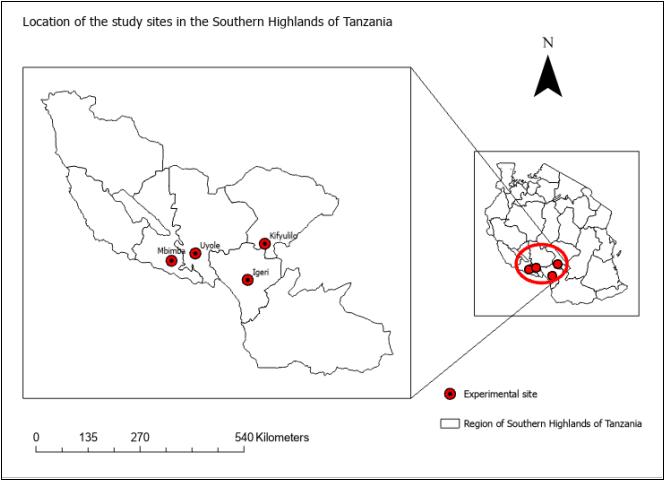
Figure 1. Location of study sites in the representative acid affected agroecological zones of the Southern Highlands of Tanzania. Map’s shapefiles were obtained from national bureau of statistics, Tanzania.
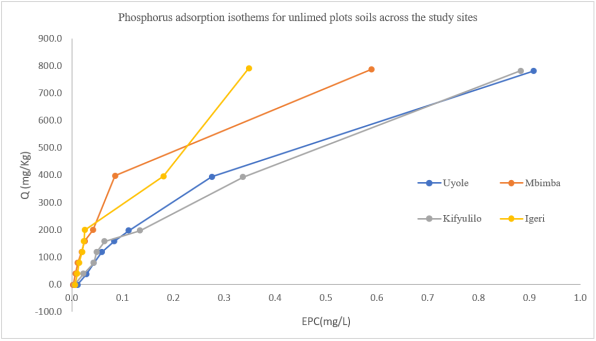
Figure 2. Adsorption isotherms of the unlimed soils of the study sites in the representative agroecological zones of Southern Highlands of Tanzania.
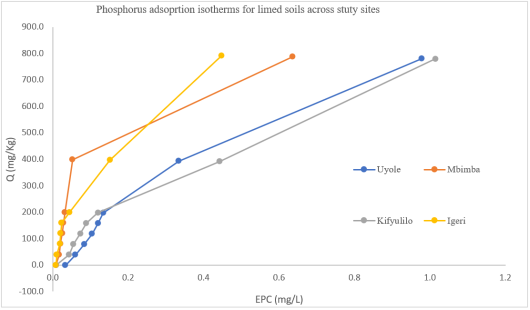
Figure 3. Adsorption isotherms of the limed soils of the study sites in the representative agroecological zones of Southern Highlands of Tanzania.
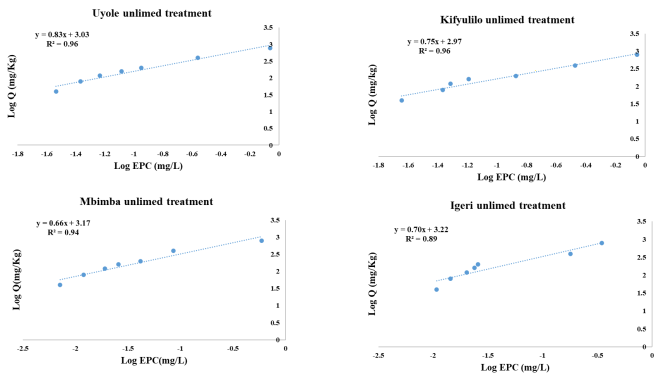
Figure 4. The Freundlich linear model graphs of unlimed soils in the Southern Highland Zones of Tanzania.
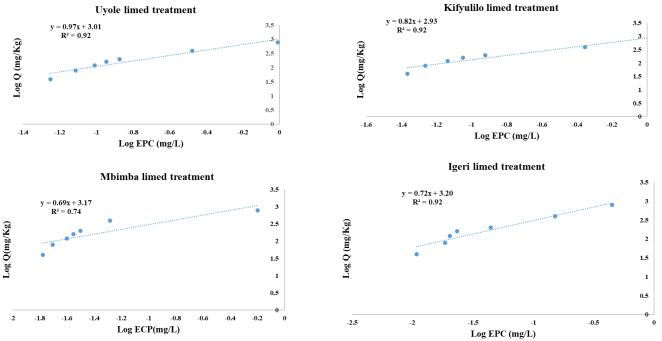
Figure 5. Freundlich linear model graphs of limed soils in the Southern Highlands of Tanzania.
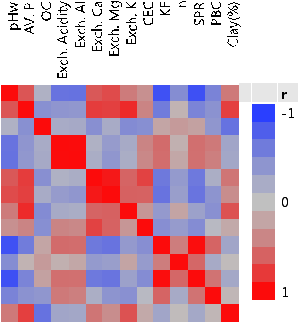
Figure 6. The heatmap on correlation coefficients of soil properties and the Freundlich Adsorption properties across the study sites.

Information



 Share This Article
 Twitter
 Linked In
 Facebook
 Copy
Copy Download